
To this point in the election, the biggest surprise has been the insurgent candidacy of reality television star Donald Trump. The strength of his candidate has clearly hinged on two things: his ability to project his views independent of the legacy media (his reach is astounding via Twitter) and his positioning as an insurgent right wing candidate against the orthodoxy of party media and discipline. For all the attachment to party structures and the historical right, there is a spirit of rebellion to various Tea Party groups. The main hashtags organizing Trump’s online presence have been #Trump2016 and #makeamericagreatagain. As a part of this project, I have been tracking the basic Trump hashtag for sometime.
One aspect of Trump analysis could take the form of network mapping, this approach would either create a pseudo-network of users to terms, or my favorite approach to map the @ network of a large slice as a conversation network. Another approach is to use computer topic modeling to read all of the Tweets. This post will do that, using Mallet deployed through R. This is a rough topic model of all #Trump2016 material so far.
I will write a more complete methodological entry about my approach here later. Right now, I have some processing power and software issues, my University will resolve these soon. Also, building libraries of stopwords is tricky, as little phatic and coordinating moments are of great interest for critical/cultural research, which generally hasn’t been the core audience for topic modeling systems.
The Data
At first these topic lines may seem silly, but they do represent connections between terms across the tweets recognized by the topic modeler. This dendrogram shows how topics are merged together to represent the entire Trump dataset.
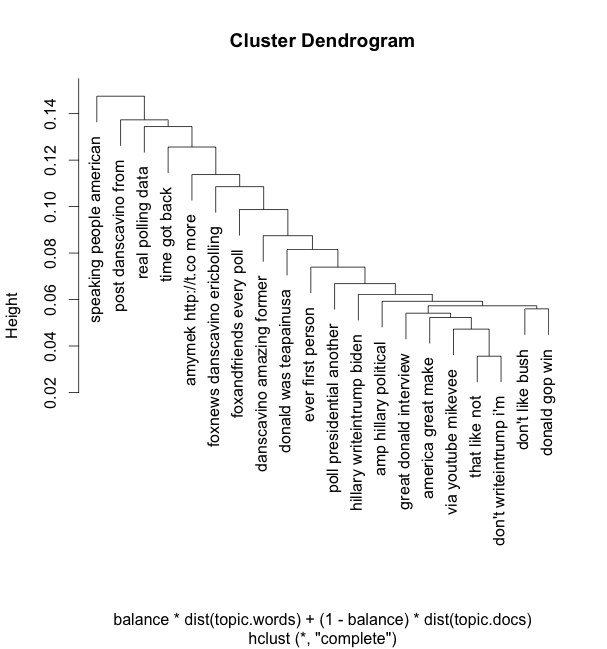
As you can see Clinton and Biden make in the topic labels, as does a one Republican, in the appropriately named label: don’t like bush.
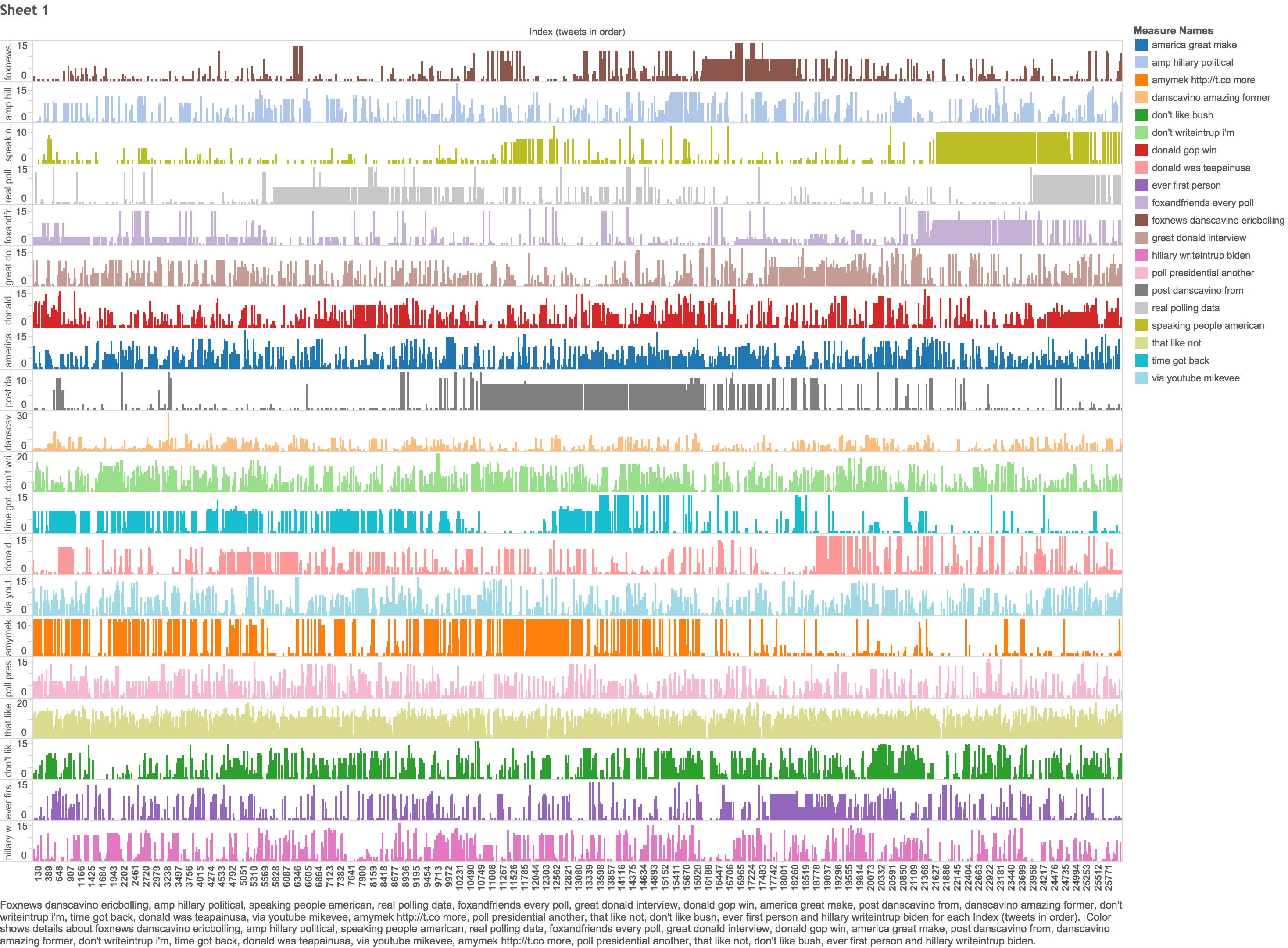
This is the analysis of the flow of those patterns so far. notice the large gray blob in the center – this is a field of activity basically run by danscavino, a former Trump advisor. During the time around the debate he basically was the Twitter conversation. The olive green topic appears later and is now important, the message of these tweets: the American people are speaking. Much of this blocking comes from retweet storms where users retweet or redeploy an image macro or link. The impact of Twitter shortened URLs in particular has fallen off, this is the popsicle orange color in the lower half of the chart.
An analysis of the data as a network might give some additional information about diffusion and network structure, given the inclusion of television programs and personalities in the list of topic labels it seems possible, if not likely that this approach to topic modeling has also identified key figures in the discourse network.
If other research about the dimensions of the cultural position of conservative populism is any guide, the deployment of the “people speaking” in the Twitter stream suggests that the rhetorical frames of the Tea Party have fused with the Trump campaign. The hostility of these frames for the traditional steering media of the conservative public sphere combined with the demand for real data/polls suggests that the underlying argument that Trump trumps pundits may have real resonance. Over in the “who is winning” tab a similar analysis suggests that Trump on immigration is a central category, and that Sanders and Clinton are more likely to appear as mineable topics than other candidates.
Does this mean that Trump could win the nomination? Unknown. Could it be that we should take a step back and honestly measure if we think that Twitter is a proxy for real public affect? Yeah, that would be really important. Furthermore, this approach does not attempt sentiment analysis, so it is possible that many of these tweets may actually be negative for Trump. This mismatch between intensity and valence was a major issue for the Romney campaign in 2012, remember, they were winning Twitter after all. Or at least, that is what they said.