
The final democratic debate before the Iowa caucuses was held on Sunday night. Post-debate questions almost always include: who won? Aggregated polling methods have proved to be a good tool for shifting journalism toward more productive questions. Unfortunately, aggregated polling is more difficult in these elections. We can try to get some leverage on the question of “who is winning Twitter,” although if you have followed my research you would know that judging the disposition of Twitter as a whole is a dubious enterprise.
Twitter conversation related to the debate, was underwhelming. The balance of retweets to tweets was two-to-one, which is not surprising given that Twitter tends to become a broadcasting medium during crises, rather than a dialogic medium. So, how do we get a sense of the temperature of Twitter when it is so erratic?
Here is the first dendrogram:
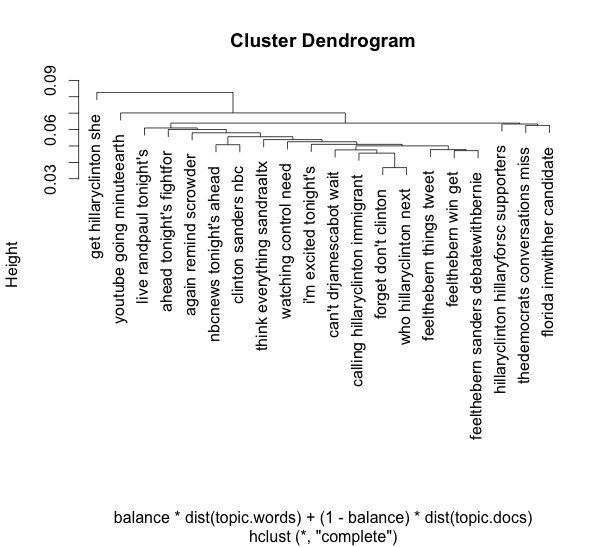
Here is the problem: most of these posts just seem to include the names of candidates. Not policy positions. As a general overview, Sanders was the subject of roughly one-thousand more Tweets than Clinton.
The retweet leader was from Donald Trump, “Notice that illegal immigrants will be given ObamaCare and free college tuition nothing has been mentioned about our VETRANS”
Followed by Sanders: I got into politics not to figure out how to become President. I got into politics because I give a damn.
Then a Sanders quote: “I believe in a society where all people do well, not just a handful of billionaires.” – Bernie
Aside from Huckabee attempting a racist joke, the Trump veterans argument, the top of the debate re-tweet stack was Sanders heavy.
Much of the retweet activity came in repeated calls to follow a live-tweet or sign-up for Clinton’s text message update plan. If we are judging by which selection of retweets named someone the most, a sort of emotional expressive politics, Sanders won. Although, parsing robots and retweets could just as easily mean that a server somewhere won.
Even when using Twitter’s metadata to sort retweets, most of the original content appears to be unoriginal. Many uncoded retweets and other such noise. Even in the ostensibly original content, a third mentions sanders, and roughly a quarter mentions Clinton. Using immigration as a proxy for issue engagement, only 41 of the 11,000 original tweets contain that string. Isis appeared 70 times. It seems that the bulk of material in this original content section are declarations of support for one candidate or the other.
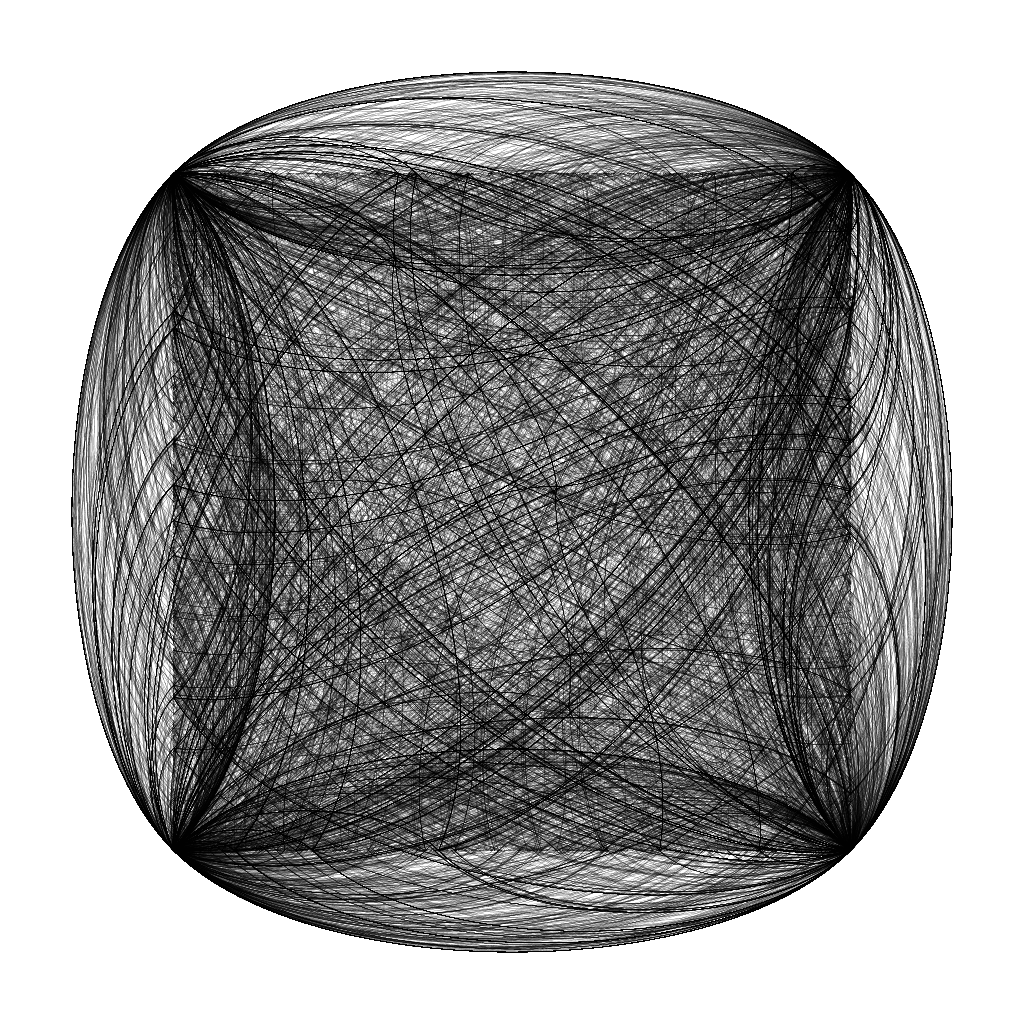
When structured as a network, there are a few clear cores of activity. The most powerful individual nodes are the conservative jjauthor and former Fox personality Steven Crowder. Nearly tied with Crowder was People4Bernie, followed then by a cluster of, Hillary Clinton, The Democrats, SandraALTX, PoliticalMiller, Hillary4Florida, GlennHeiser, YouTube, RandPaul, ZaidJilani, BernieSanders and HillaryClinton originals (rather than retweets) appear in this region as well. After this group there is a rapid fall in centrality of any given node.
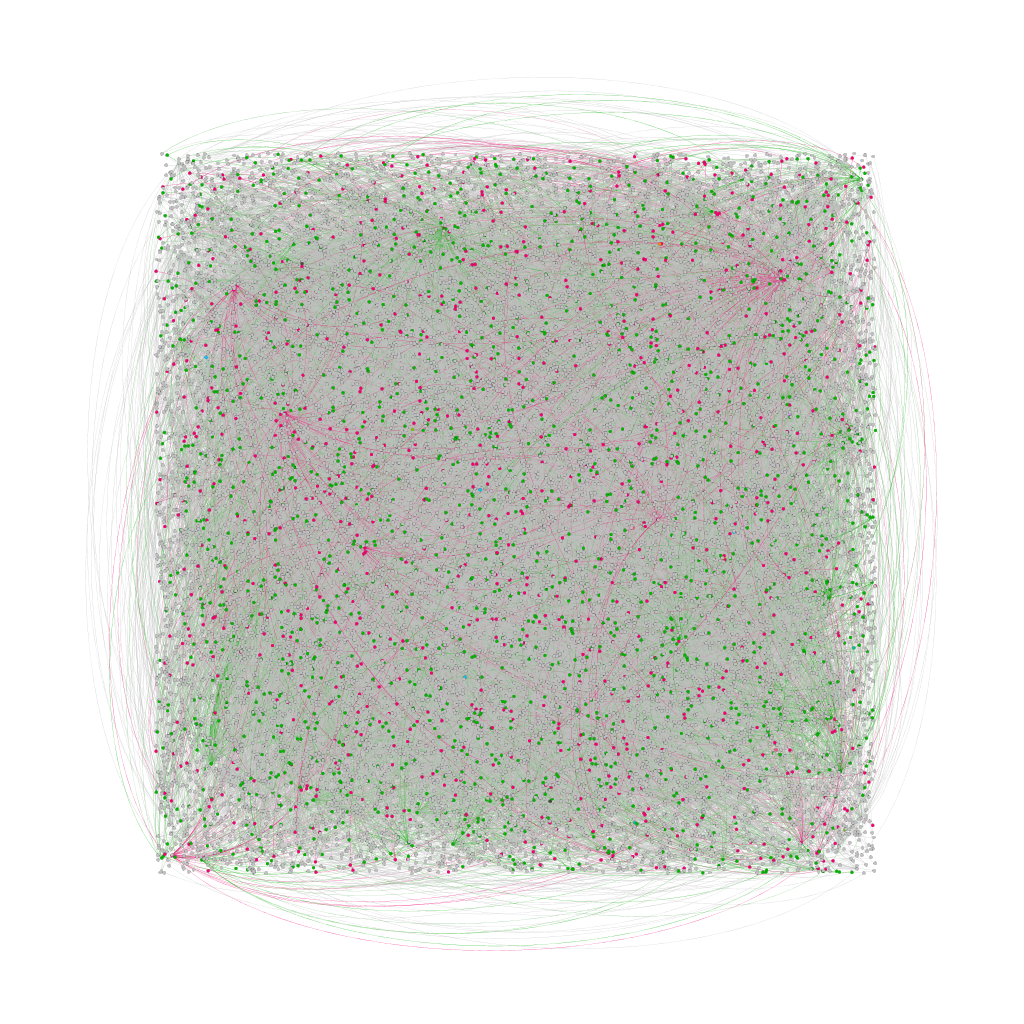
The green and red modularities are only roughly an eighth of all computer detected in this network. In short, there are tens of thousands of people talking to each other, with very little meaningful network control. Unless you are a Conservative author, in which case you have something.
People4Bernie clearly was the strongest handle in the network flow, although there were also strong Clinton handles. This high eigenvector score suggests that Sanders could more effectively seed information into the conversation by way of his supporters.
So, who won?
The Sanders organization had great strength in controlling message flow, although Clinton also had a good bit of traction. It is fascinating that from this perspective the most retweeted (Trump) has almost no meaningful centrality to this network. In short, Sanders was running Twitter, but that may not mean much.